| |
 |
|
|
IntellaTurn's Weekly Scoop
By Erin at IntellaTurn ● Oct 15, 2026
🎃Note: we’re on fall break and will resume publication on Nov. 5.
This week: Drug approvals | Around the industry | FDA’s latest rare disease framework | Top biopharma conferences for 2027
|
| |
|
Source: iStock / iQoncept
✅ ImmunityBio’s ANKTIVA: First treatment for certain people with BCG-unrensponsive bladder cancer
-
Following a bumpy regulatory road that involved a refusal-to-file, ImmunityBio has won FDA approval to expand Anktiva (nogapendekin alfa inbakicept-pmln) into papillary-only non-muscle-invasive bladder cancer (NMIBC).
-
Wednesday’s approval comes nearly three months ahead of the FDA’s target decision date.
-
The go-ahead covers Anktiva, given with Bacillus Calmette-Guérin (BCG), in BCG-unresponsive NMIBC patients with high-grade papillary-only tumors.
-
The drug’s original FDA approval in 2024 is in patients with carcinoma in situ (CIS) with or without papillary tumors.
-
To expand Anktiva’s label, the FDA adopted a novel approach to how it evaluates treatments for BCG-unresponsive NMIBC, the agency noted in a press release.
-
The new regulatory path essentially allowed ImmunityBio to bypass an expensive randomized phase 3 trial that competitor Johnson & Johnson is currently grinding through. (Fierce Pharma)
✅ Asahi Kasei’s HOVILPRI: New option for treating lesions caused by herpes simplex virus infection
-
Patients with lesions caused by herpes simplex virus have a new FDA-approved treatment option, an oral antiviral drug from Asahi Kasei.
-
The late Friday regulatory decision covers the treatment of adults whose lesions do not respond to the three oral antivirals that make up the current standard of care.
-
Asahi Kasei’s once-daily pill, known in development as pritelivir, will be commercialized under the brand name Hovilpri. (MedCity News)
✅ Roche’s TECENTRIQ: 12th label expansion for adjuvant treatment of stage III colon cancer with dMMR
-
Roche added a twelfth US indication to Tecentriq (atezolizumab).
-
The FDA approved the programmed death-ligand 1 (PD-L1) inhibitor and its subcutaneous formulation with hyaluronidase-tqjs (Tecentriq Hybreza) for adjuvant treatment of stage III colon cancer with deficient DNA mismatch repair (dMMR), the company announced.
-
The regimen pairs the immunotherapy with a fluoropyrimidine and oxaliplatin in a biomarker-defined patient group. (PharmExec)
|
| |
|

Source: Axios Visuals
➡️ Ultragenyx rare disease voucher sales secure $413M for more potential pipeline building
-
Ultragenyx Pharmaceutical recently received two separate FDA approvals for gene therapies in the span of a month, each regulatory nod accompanied by a voucher the company could use to speed up the future review of another rare disease drug.
-
In the past week, Ultragenyx has reached separate deals to sell each regulatory fast pass.
-
The Novato, California-based biotech announced Wednesday a definitive agreement to sell a voucher for $203 million, following a deal last week to sell a voucher for $210 million.
-
The identities of both voucher buyers were undisclosed and the purchases still need to meet closing conditions. But the deals put Ultragenyx in line for non-dilutive capital that the rare disease specialist can use to bolster its drug pipeline.
-
Congress created the voucher program to incentivize drug development in rare diseases. Companies awarded a regulatory approval in a rare pediatric disease can receive one of these vouchers, which cuts the standard review time of 10 months down to six. (MedCity News)
➡️ Undecimal Bio debuts with $18M to improve siRNA delivery using AI
-
Undecimal Bio launched on Tuesday with $18 million in seed financing to develop an AI-powered platform designed to identify conjugates that can deliver siRNA medicines to tissues other than the liver, a challenge that has long hampered the modality.
-
The oversubscribed round was co-led by 4BIO Capital and IQ Capital. The startup, spun out of Eleven Therapeutics, plans to use the funding to expand its DELiveri platform and advance its initial programs targeting renovascular disease.
-
DELiveri combines large-scale screening of synthetic compounds with AI models that analyze which chemical structures successfully deliver siRNA into cells.
-
The company said it has screened over 15 million compounds across at least 10 tissues, generating more than 500 million data points on how different chemical structures perform in delivering molecules inside cells. (FirstWord)
➡️ AstraZeneca blames trial design for ph3 failure of bone disease drug
-
New details from AstraZeneca’s failed phase 3 trial of its enzyme replacement therapy for a genetic bone disease suggest the study missed its goals because of how it was composed.
-
The treatment, efzimfotase alfa, is under FDA priority review with a decision due in the first half of 2027. It’s for a disease called hypophosphatasia that can cause bones to weaken, affecting strength and mobility.
-
The company first reported in March that the phase 3 trial had failed after not meeting statistical significance on a test of patients’ walking. At the time, it blamed the results from a subgroup of adult patients.
-
Recent data add new details. In the trial, called HICKORY, patients given injections of efzimfotase alfa for 25 weeks were able to walk an average 17.05 meters more in six minutes than they could at baseline, compared with placebo patients.
-
AstraZeneca claims those results didn’t hit statistical significance in part because of a subgroup of patients with adult-onset disease. (Endpoints)
|
| |
|
TrendWatch: FDA’s latest rare disease framework seeks to prioritize consistency in flexibility

Source: Axios Visuals
What’s new: The FDA revealed a new framework Wednesday for its approach to rare disease drug regulation built to encourage innovation by standardizing the way clinical trial requirements are applied across diseases.
To allow for a faster and more systematic path for as many as 10,000 different rare conditions affecting 30 million Americans, the FDA said drug development should account for nuance by approaching each disease based on the evidence that can be realistically generated in small patient populations.
What he’s saying: “As we learn more about rare diseases and better understand the breadth of suffering they cause, we must ensure that America’s regulatory system remains at the forefront—prepared to respond to emerging science, anticipate the needs of patients and families, and help bring safe and effective therapies to those who need them,” Acting FDA Commissioner Kyle Diamantas said in a prepared statement accompanying the announcement of the Rare Disease Framework Initiative.
Context: In a white paper elaborating on the new framework, the agency touted its current rare disease programs, including the FDA Rare Disease Innovation Hub, the Center for Drug Evaluation and Research (CDER)’s Accelerating Rare disease Cures (ARC) program and the Rare Disease Endpoint Advancement (RDEA) pilot program, a collaboration between CDER and the Center for Biologics Evaluation and Research (CBER).
“We need to build on, systematize and operationalize these individual efforts into a consistently utilized, cross-center approach that champions the use of cutting-edge science, novel methodologies and innovative statistical approaches,” the FDA wrote.
Go deeper: BioSpace
|
| |
|
Interesting read: The top biopharma conferences in 2027

Source: Axios Visuals
Setting the stage: Clinical trial results are the key events that make or break a biotechnology company.
-
Positive data can validate a drugmaker’s business plan and boost its stock price, while a disappointing readout can change its course.
-
These crucial findings are often presented and closely analyzed at medical conferences throughout the year — meetings where companies get to showcase the medicines they’ve staked their futures on.
Driving the news: These conferences have different focuses. Some spotlight early research or the final trials that can yield regulatory approvals. Others are temperature takers for the industry’s health, where companies and investors gather to network and cut deals.
Below: A snapshot of schedules for the key medical meetings and conferences planned for 2027.
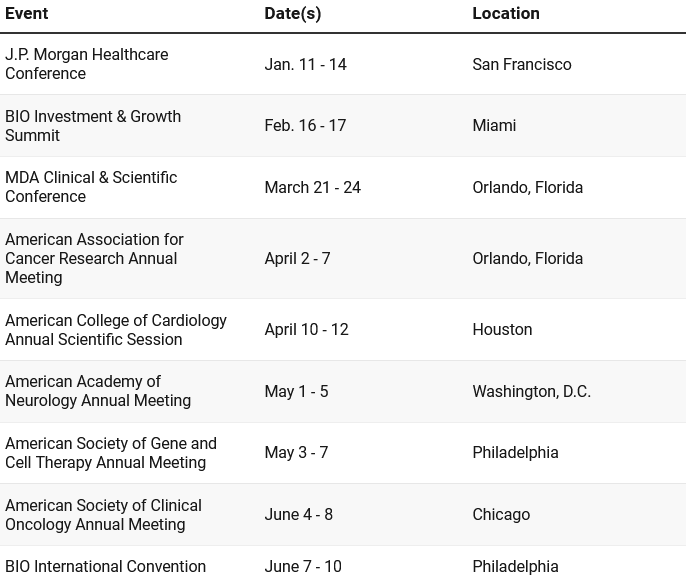
Table: Ben Fidler/BioPharma Dive
|
Read the full article: BioPharma Dive
|
| |
|
✨ Thanks for reading! ✨
🌐 About us: IntellaTurn, LLC delivers business-critical and timely information to biopharmaceutical companies and start-ups in the life sciences industry.
📧 Questions? If you liked this, but need more tailored business insights, get in touch about our curated daily, weekly, and bi-weekly newsletters.
|
| |
|
|
|
|
|
|
|

